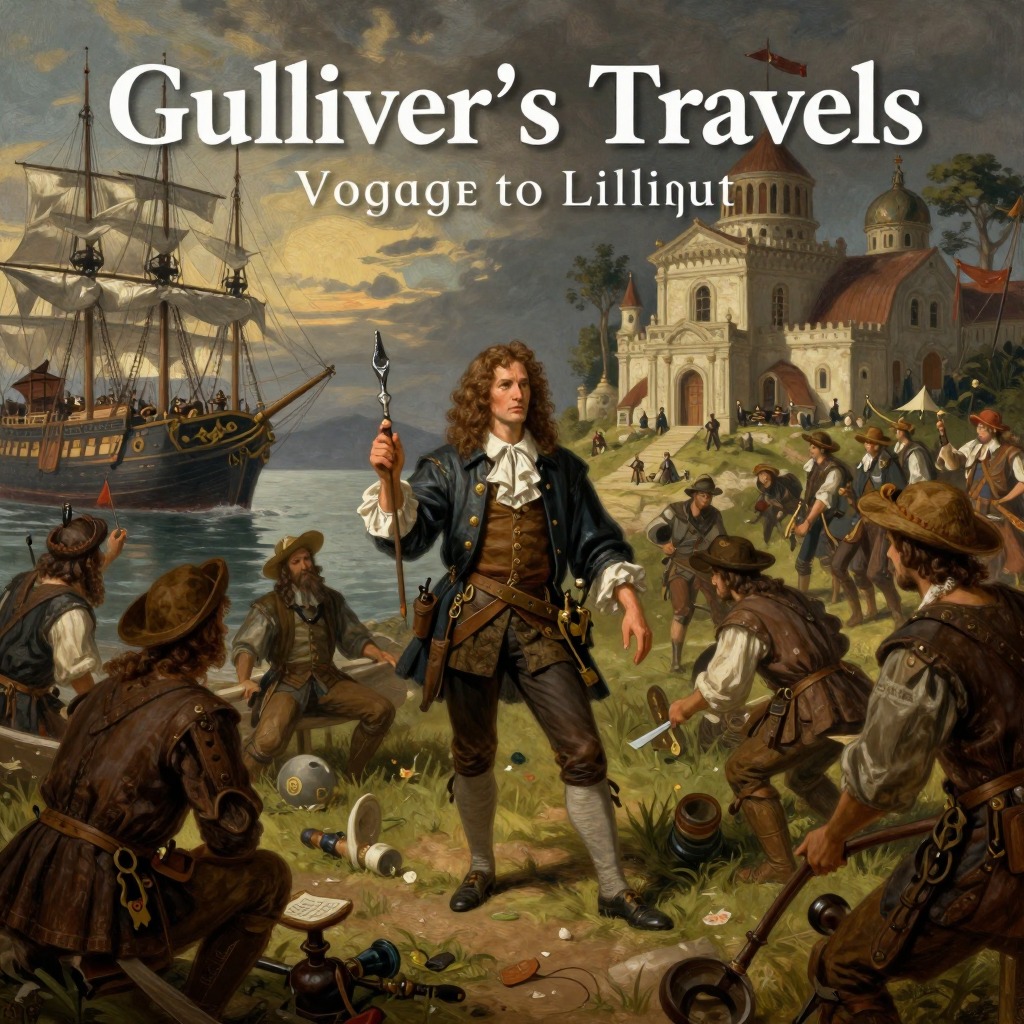
Capture of the Blefuscu fleet
The Capture of the Blefuscu fleet is the central military exploit of Gulliver's first voyage and the action that transforms him from a captive curiosity into the most powerful subject of the Lilliputian empire. By wading the channel that separates the two warring kingdoms, cutting the cables of fifty enemy men-of-war under a hail of arrows, and towing the entire fleet back to the royal port of Lilliput, Gulliver single-handedly prevents an invasion and secures a peace. The feat is at once a demonstration of raw physical dominance and a satirical set-piece that reduces international conflict to the scale of a children's game, while its aftermath—the emperor's demand for total conquest, Gulliver's refusal, and the ensuing court intrigue—reveals the corrosive ambition and ingratitude that govern even the most diminutive of princes.
Background and Strategic Context
The empire of Blefuscu is an island situated to the north-northeast of Lilliput, separated only by a channel eight hundred yards wide. At the time of Gulliver's arrival, the two empires had been engaged in a bitter war for six-and-thirty moons, a conflict that had cost Lilliput forty capital ships, a much greater number of smaller vessels, and thirty thousand of its best seamen and soldiers. The war's origin lay in a religious schism over the proper end at which to break an egg—the Big-endian heresy versus the Small-endian orthodoxy—a dispute that had already caused six rebellions, the death of one emperor, and the loss of another's crown. The Blefuscudians had now equipped a numerous fleet and were preparing to make a descent upon Lilliput. Gulliver, having learned the language and won the favor of the court, was approached by Reldresal, the principal secretary for private affairs, who laid the entire account before him. Gulliver responded by offering, with the hazard of his life, to defend the emperor's person and state against all invaders.
The Stratagem and the Wading
Gulliver communicated to the emperor a project for seizing the enemy's whole fleet. He first consulted the most experienced seamen on the depth of the channel, learning that at high water the middle was seventy glumgluffs deep—about six feet of European measure—and the rest fifty glumgluffs at most. Walking to the northeast coast opposite Blefuscu, he lay down behind a hillock and viewed the enemy's fleet through his pocket perspective glass: about fifty men-of-war and a great number of transports lay at anchor in the harbor, ready to sail with the first fair wind. Returning to his house, he obtained a warrant and ordered a great quantity of the strongest cable and bars of iron. The cable was about as thick as packthread, and the bars of the length and size of a knitting needle. He trebled the cable to make it stronger and twisted three of the iron bars together, bending the extremities into a hook. Having thus fixed fifty hooks to as many cables, he went back to the northeast coast, put off his coat, shoes, and stockings, and walked into the sea in his leathern jerkin about half an hour before high water. He waded with what haste he could and swam in the middle about thirty yards till he felt ground, arriving at the fleet in less than half an hour.
The Cutting and the Towing
The enemy were so frightened at the sight of Gulliver that they leaped out of their ships and swam to shore, where there could not be fewer than thirty thousand souls. Gulliver then took his tackling and fastened a hook to the hole at the prow of each ship, tying all the cords together at the end. While thus employed, the enemy discharged several thousand arrows, many of which stuck in his hands and face, causing excessive smart and much disturbance to his work. His greatest apprehension was for his eyes, which he would infallibly have lost had he not suddenly thought of an expedient: he took out the pair of spectacles he kept in a private pocket that had escaped the emperor's searchers, fastened them as strongly as he could upon his nose, and went on boldly with his work in spite of the arrows, many of which struck against the glasses without any other effect than a little to discompose them. Having fastened all the hooks, he took the knot in his hand and began to pull, but not a ship would stir, for they were all too fast held by their anchors. He therefore let go the cord, left the hooks fixed to the ships, and resolutely cut with his knife the cables that fastened the anchors, receiving above two hundred shots in his face and hands. Then he took up the knotted end of the cables to which his hooks were tied and, with great ease, drew fifty of the enemy's largest men-of-war after him. The Blefuscudians, who had not the least imagination of what he intended, were at first confounded with astonishment. They had seen him cut the cables and thought his design was only to let the ships run adrift or fall foul on each other; but when they perceived the whole fleet moving in order and saw him pulling at the end, they set up such a scream of grief and despair as it is almost impossible to describe or conceive. When he had got out of danger, he stopped awhile to pick out the arrows that stuck in his hands and face and rubbed on some of the same ointment that had been given him at his first arrival. He then took off his spectacles and, waiting about an hour till the tide was a little fallen, waded through the middle with his cargo and arrived safe at the royal port of Lilliput.
The Emperor's Reception and the Aftermath
The emperor and his whole court stood on the shore expecting the issue of this great adventure. They saw the ships move forward in a large half-moon but could not discern Gulliver, who was up to his breast in water. When he advanced to the middle of the channel, they were yet more in pain because he was under water to his neck. The emperor concluded him to be drowned and that the enemy's fleet was approaching in a hostile manner, but he was soon eased of his fears; for the channel growing shallower every step, Gulliver came in a short time within hearing and, holding up the end of the cable by which the fleet was fastened, cried in a loud voice, "Long live the most puissant emperor of Lilliput!" This great prince received him at his landing with all possible encomiums and created him a nardac upon the spot, which is the highest title of honor among them. The emperor then desired Gulliver to take some other opportunity of bringing all the rest of the enemy's ships into his ports, for his ambition seemed to think of nothing less than reducing the whole empire of Blefuscu into a province, governing it by a viceroy, destroying the Big-endian exiles, and compelling that people to break the smaller end of their eggs. But Gulliver endeavored to divert him from this design by many arguments drawn from the topics of policy as well as justice, and plainly protested that he would never be an instrument of bringing a free and brave people into slavery. When the matter was debated in council, the wisest part of the ministry were of his opinion. This open, bold declaration was so opposite to the emperor's schemes that he could never forgive Gulliver; it was mentioned in a very artful manner at council, and from this time began an intrigue between his majesty and a junto of ministers maliciously bent against Gulliver, which broke out in less than two months and had like to have ended in his utter destruction. About three weeks after the exploit, a solemn embassy arrived from Blefuscu with humble offers of peace, which was soon concluded upon conditions very advantageous to the Lilliputian emperor. The six ambassadors, with a train of about five hundred persons, made a magnificent entry, and when their treaty was finished, Gulliver did them several good offices by the credit he then had at court. They made him a visit in form, began with many compliments upon his valor and generosity, invited him to that kingdom in the emperor their master's name, and desired him to show some proofs of his prodigious strength. Gulliver readily obliged them, and the next time he had the honor to see his own emperor, he desired general license to wait on the Blefuscudian monarch, which was granted in a very cold manner—a sign that Flimnap and Bolgolam had already represented his intercourse with those ambassadors as a mark of disaffection. This was the first time Gulliver began to conceive some imperfect idea of courts and ministers.
Thematic Significance
The capture of the Blefuscu fleet is the action that most vividly embodies the satirical core of the Lilliput voyage. The entire military operation—the wading, the cutting, the towing—is described with the precise, circumstantial detail of a genuine naval exploit, yet the scale is absurdly miniature: the cables are packthread, the iron bars are knitting needles, and the enemy's largest men-of-war are small enough for one man to drag. The disproportion between the heroic narrative voice and the trivial dimensions of the conflict produces a sustained irony that undercuts every claim to glory. More pointedly, the aftermath reveals that the emperor's gratitude is conditional on absolute submission: when Gulliver refuses to become an instrument of conquest and enslavement, his great service is immediately turned against him. The nardac title, the highest honor in the realm, becomes the prelude to a conspiracy that will accuse him of high treason. The action thus serves as the hinge of the entire Lilliputian plot: it raises Gulliver to the peak of favor and simultaneously provides the grounds for his destruction, exposing the mechanism by which absolute power rewards service only as long as it serves ambition, and punishes conscience as the worst form of treason.